
Best MPG Toyota 2026: Fuel Economy Guide, Beaumont TX
Ranking Toyota's 2026 lineup by EPA mpg, with a real-world savings calculation for Beaumont, TX commuters weighing hybrid vs gas trade-offs.

The Toyota with the best gas mileage in 2026 is the Camry Hybrid LE FWD, rated at roughly 53 city / 50 highway / 51 mpg combined per manufacturer EPA estimates. The Corolla Hybrid and Prius family are close behind, and among SUVs, the RAV4 Hybrid leads at about 39–40 mpg combined. Whether the fuel savings are worth the higher sticker price depends on how many miles you drive around Beaumont and how long you plan to keep the vehicle.
For most Southeast Texas commuters running I-10, US-69, or the loop between Beaumont, Port Arthur, and Orange, the math tips in favor of a hybrid within three to five years of ownership. For work-truck buyers who need towing capacity, it doesn't — and that's the honest tension this guide unpacks.
Which 2026 Toyota gets the best gas mileage overall?
The Camry Hybrid LE FWD leads Toyota's 2026 lineup at approximately 53 city / 50 highway / 51 mpg combined. The Corolla Hybrid follows in the low-50s combined, and the RAV4 Hybrid tops the SUV category near 40 mpg combined. Every top-ranked Toyota for fuel economy in 2026 is a hybrid — the gap over gas-only models is that decisive.
Here is how the Toyota lineup ranks by EPA combined mpg, based on manufacturer specifications for current model-year vehicles you'd find on a Beaumont dealer lot, including at Donalson Toyota:
| Model | Powertrain | EPA Combined MPG (approx.) | Body Style |
|---|---|---|---|
| Camry Hybrid LE FWD | 2.5L I-4 hybrid | 51 mpg | Midsize sedan |
| Camry Hybrid LE AWD | 2.5L I-4 hybrid | 50 mpg | Midsize sedan |
| Corolla Hybrid | 1.8L I-4 hybrid | ~50 mpg | Compact sedan |
| Camry Hybrid SE/XLE FWD | 2.5L I-4 hybrid | 47 mpg | Midsize sedan |
| RAV4 Hybrid | 2.5L I-4 hybrid AWD | 39–40 mpg | Compact SUV |
| Sienna | 2.5L I-4 hybrid | ~36 mpg | Minivan |
| Highlander Hybrid | 2.5L I-4 hybrid | 35 mpg | 3-row SUV |
| Corolla (gas) | 2.0L I-4 | ~32 mpg | Compact sedan |
| RAV4 (gas) | 2.5L I-4 | ~29 mpg | Compact SUV |
| Highlander (gas) | 2.4L turbo I-4 | ~22–24 mpg | 3-row SUV |
| Tacoma | 2.4L turbo I-4 | ~19–23 mpg | Midsize truck |
| Tundra | 3.4L twin-turbo V6 | ~17–20 mpg | Full-size truck |
Always confirm exact ratings on the Monroney window sticker, since trim, wheel size, and drivetrain change the numbers.
What is the most fuel efficient Toyota SUV in Beaumont, TX?
The RAV4 Hybrid is Toyota's most fuel-efficient SUV in 2026, rated at roughly 41 city / 38 highway / 39–40 mpg combined with standard electronic AWD. Car and Driver notes the RAV4 Hybrid beats the gas RAV4 by 14 mpg city, 5 mpg highway, and 11 mpg combined. For Beaumont buyers who want SUV space without truck-level fuel bills, it's the clear pick.
The Highlander Hybrid, at about 35 mpg combined, is the fuel economy leader among three-row Toyotas — meaningful if you're shuttling kids across BISD or making regular trips down to the Beaumont Municipal Airport area or over to Baptist Hospitals of Southeast Texas. The Woodland Edition RAV4 Hybrid drops slightly to about 38 city / 35 highway / 37 combined, a small trade for its off-road-oriented tuning.
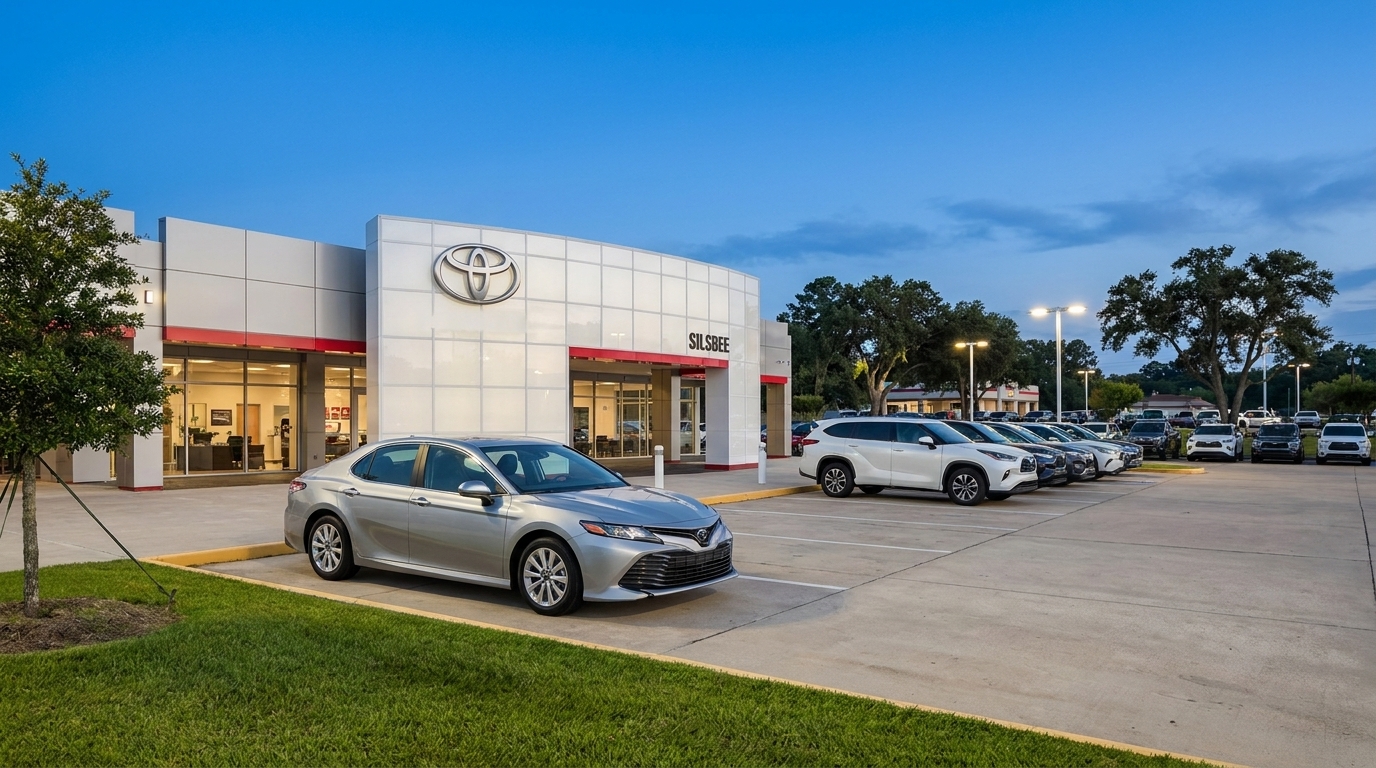
Donalson Toyota, serving Beaumont from nearby Silsbee, typically stocks RAV4 Hybrid and Highlander Hybrid inventory across LE, XLE, and Limited trims — the volume trims where the fuel-economy-per-dollar equation works out cleanest.
How much do you actually save with a Toyota hybrid in Beaumont?
A Beaumont driver covering 15,000 miles per year saves roughly $600–$900 annually by choosing a Camry Hybrid over a comparable gas Camry, and about $500–$800 by choosing a RAV4 Hybrid over a gas RAV4, at typical Southeast Texas gas prices. Over a 6-year ownership span, that's $3,000–$5,000 in fuel — usually more than the hybrid's price premium.
The real Beaumont-specific factors that push the math further toward hybrids:
- Gulf Coast heat and stop-and-go traffic. Hybrids shine in the city cycle because they capture braking energy and run on electric power at low speeds. Idle-heavy commuting on College Street or through downtown Beaumont is where gas engines waste the most fuel.
- Evacuation range. Hurricane season runs June through November, and a Camry Hybrid can cover 600+ miles on a tank — a genuine advantage when I-10 turns into a parking lot heading toward Houston or Austin.
- Texas has no state emissions inspection outside major metros, but Jefferson County still requires an annual safety inspection. Hybrid drivetrains have no additional inspection burden here.
Is the hybrid premium worth it for a Beaumont commuter?
For most Beaumont commuters driving 12,000+ miles per year and planning to keep the vehicle five years or longer, yes — the hybrid premium pays back in fuel savings before the loan is paid off. For low-mileage drivers under 8,000 miles per year, or buyers who trade every two to three years, a gas Corolla or gas RAV4 often makes better financial sense.
The break-even calculation is simple: take the hybrid's price premium (typically $1,000–$3,000 over a comparable gas trim), divide by your annual fuel savings, and you get the payback period in years. If you'll own the car longer than that, the hybrid wins on total cost. If not, the gas model wins on upfront cost.
Truck buyers face a different calculation entirely. If your work requires towing a boat to Sea Rim State Park, hauling equipment to a job site, or handling flooded roads after a tropical system, a Tacoma or Tundra earns its lower mpg through capability a RAV4 Hybrid simply can't match.
What should Beaumont buyers look for at the dealership?
Beaumont buyers should compare Monroney-label EPA ratings across specific trims (not just model averages), verify AWD versus FWD mpg differences, and ask for the out-the-door price including TT&L before comparing hybrid to gas versions. The hybrid premium varies by trim — a base LE hybrid may cost less over a comparable mid-trim gas model than you'd expect.
Donalson Toyota's 4.7-star rating across more than 1,110 Google reviews reflects the transparent, unhurried buying approach Beaumont-area buyers tend to describe — one recent reviewer noted that their salesperson "was absolutely thorough explaining every part of the car before we purchased." That kind of walk-through matters more with hybrids, where the powertrain, battery warranty, and driving-mode behavior all deserve real explanation before you sign.
Ask specifically about the hybrid battery warranty coverage (Toyota's hybrid battery warranty runs 10 years or 150,000 miles on current models) and confirm any regional or trim-specific packages before you commit.
Frequently asked questions
What is the single best-mpg Toyota you can buy in 2026?
The Camry Hybrid LE FWD leads Toyota's 2026 lineup at approximately 53 city / 50 highway / 51 mpg combined per manufacturer EPA estimates. The Corolla Hybrid runs close behind in the low-50s combined. Both meaningfully outperform any gas-only Toyota and any Toyota SUV or truck, hybrid or not, on pure fuel economy.
Does the RAV4 Hybrid get better mileage than the gas RAV4?
Yes, significantly. The RAV4 Hybrid is rated at roughly 39–40 mpg combined versus about 29 mpg for the gas RAV4 — a difference of roughly 11 mpg combined, or a 35–40% improvement. The hybrid also comes standard with electronic AWD, while AWD on the gas RAV4 is a separate option that further reduces its fuel economy.
How much more does a Toyota hybrid cost than the gas version?
The hybrid premium typically runs $1,000–$3,000 over a comparably equipped gas trim, depending on the model. The RAV4 Hybrid is usually about $1,000–$2,000 above the gas RAV4 at similar trim levels. The Camry and Sienna are hybrid-only in current model years, so there is no direct gas comparison available on those two.
Is a Corolla Hybrid worth it for a Beaumont commuter?
For a Beaumont commuter driving 12,000+ miles per year, the Corolla Hybrid usually pays back its price premium within three to four years through fuel savings. It's especially strong for stop-and-go city driving where hybrid efficiency peaks. For very low-mileage drivers, a gas Corolla's lower sticker price may make more sense on total cost.
How long is Toyota's hybrid battery warranty?
Toyota's hybrid battery warranty on current models covers 10 years or 150,000 miles, whichever comes first, per manufacturer specifications. That's substantially longer than the standard powertrain warranty and addresses the most common concern buyers raise about hybrid ownership — the cost of eventual battery replacement.
Should I get a hybrid Tundra or a gas Tundra for towing?
For heavy towing, both work — the i-FORCE MAX hybrid Tundra adds power and modestly improves mpg by 1–2 combined, but overall fuel economy remains far below crossover hybrids. Choose based on how many miles you drive and whether the hybrid's extra torque matters for your use case. For light-duty needs, a RAV4 Hybrid saves far more fuel than either Tundra.
The bottom line for Beaumont drivers
If fuel economy is your top priority, the answer is straightforward: buy the Camry Hybrid or Corolla Hybrid for sedans, the RAV4 Hybrid for SUVs, the Highlander Hybrid if you need three rows, and the Sienna if you need a minivan. Every one of those tops its segment by 10–20+ mpg over the non-hybrid equivalent.
The buyers who should stay with gas are truck shoppers with genuine work or towing needs, and low-mileage drivers whose annual fuel spend is small enough that the hybrid premium won't pay back before they trade.
Readers in Beaumont, TX who want to compare hybrid and gas Toyota inventory side by side — with the Monroney labels and out-the-door pricing on the table — can reach Donalson Toyota at https://www.donalsontoyota.com/ to schedule a visit or check current stock.