
Toyota Highlander vs 4Runner: Which Is Better for Families?
Compare the 2026 Toyota Highlander vs 4Runner for families in Silsbee, TX. Seating, cargo, safety, and fuel economy — a clear buyer's guide.
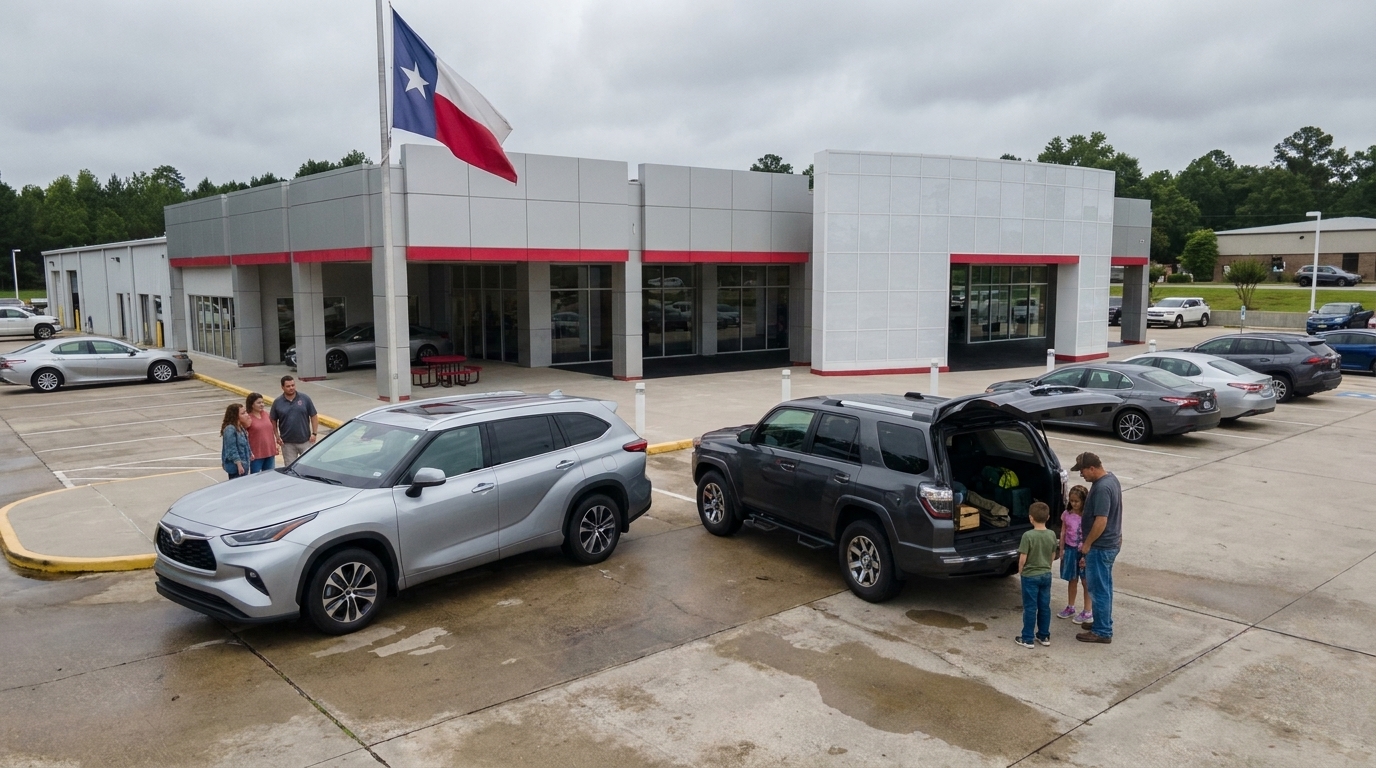
If you're a family shopper in Silsbee weighing the 2026 Toyota Highlander against the 2026 Toyota 4Runner, you're comparing two very different vehicles that happen to wear the same badge. One is a unibody three-row crossover built around comfort and efficiency. The other is a body-on-frame SUV built for towing, trail work, and long-haul durability. Both are excellent — but they solve different problems.
Here's how they stack up on the things that actually matter for a family in Southeast Texas.
The Short Answer for Silsbee Families
If your priorities are third-row seating, better fuel economy, and a car-like ride for daily school runs, work commutes into Beaumont, and highway trips down US-96, the Highlander is the more practical family choice. If you tow a boat to Sam Rayburn or Steinhagen, spend weekends on Big Thicket back roads, or need serious cargo room and 4WD hardware, the 4Runner earns its keep.
Both share Toyota Safety Sense 3.0 as standard equipment, so you're not compromising on core driver-assistance features either way.
Seating and Third-Row Practicality
This is where the two really diverge.
The 2026 Highlander seats 7 or 8 passengers — eight with the second-row bench, seven with captain's chairs. It's designed from the ground up as a three-row family hauler, and the third row is standard on every trim.
The 2026 4Runner seats 5 passengers standard, with a 7-passenger third-row option available on select trims. The 4Runner's third row is a nice-to-have, not a core design priority — it's tighter, and it's not available across the lineup.
If you regularly carry more than four people, or if carpool duty is part of your weekly routine, the Highlander is the more honest three-row.
Cargo Space for Real Family Loads
Numbers first, then context:
- Highlander: ~16 cu ft behind the third row, ~48 cu ft behind the second row, ~84 cu ft maximum with seats folded
- 4Runner (gas two-row): ~48.4 cu ft behind the second row, ~90.2 cu ft maximum. Some hybrid grades come in around ~82.6 cu ft max.
The 4Runner wins on raw maximum volume and offers a more utilitarian, boxy load area — better for coolers, camping gear, and awkward-shaped cargo. The Highlander gives up some max cubic feet but carries more people at the same time, which is usually what families actually need.
Fuel Economy on Southeast Texas Roads
Silsbee families drive a lot of highway miles — into Beaumont for work, north on US-96, or across to Lumberton and Kountze. Fuel economy adds up fast.
The Highlander is the clear efficiency leader:
- Highlander gas: up to 24 mpg combined
- Highlander Hybrid: up to 36 mpg combined (Toyota claim)
- 4Runner gas: 21–22 mpg combined
- 4Runner i-FORCE MAX hybrid: 23 mpg combined
That's a meaningful gap. A Highlander Hybrid can deliver roughly 50% better combined fuel economy than a 4Runner hybrid — a real number over a five-year ownership window, especially with Gulf Coast summer traffic and long single-driver commutes.
Power, Towing, and Capability
The 4Runner outmuscles the Highlander on paper and in practice.
- Highlander: 2.4L turbo 4-cylinder making 265 hp (gas), or a 2.5L hybrid system at 243 hp combined. Towing up to 5,000 lb (gas) or 3,500 lb (hybrid).
- 4Runner: 2.4L i-FORCE turbo at 278 hp / 317 lb-ft, or the i-FORCE MAX hybrid at 326 hp / 465 lb-ft. Towing up to 6,000 lb when properly equipped.
If you tow a bass boat, a travel trailer, or a utility trailer for property work around Hardin County, the 4Runner's body-on-frame platform, higher torque, and 1,000-lb towing advantage matter. Its available 4WD, Crawl Control, and Multi-Terrain Select also handle the muddy two-tracks and washed-out roads you'll find after heavy Gulf storms far better than the Highlander's AWD-tuned unibody.
The Highlander is not a trail vehicle. It has standard AWD on 2026 gas models and is composed on wet pavement, but it's tuned for on-road life.
Ride Comfort and Interior for Daily Family Use
The Highlander was designed to be quiet, smooth, and refined. Its unibody platform, available 12.3-inch touchscreen, head-up display, wireless charging, and multi-zone climate control make it the more relaxing daily driver — especially for kids in car seats and long trips down I-10 to Houston or east into Louisiana.
The 4Runner rides firmer. That's the tradeoff for body-on-frame durability. The cabin is more utilitarian, and some comfort features that are standard or common on the Highlander are optional or trim-restricted on the 4Runner.
For a family whose SUV mostly does school, groceries, church, and highway miles, the Highlander is the more comfortable seat over a decade of ownership.
Pricing: What to Expect in the Silsbee Market
The 4Runner has the lower published entry point:
- 2026 4Runner SR5: approximately $43,665 (Cars.com) to $44,070 (Edmunds)
- 2026 Highlander Hybrid XLE: approximately $49,115 (KBB). Toyota has not yet published a full official U.S. MSRP grid for 2026 Highlander gas trims, so gas base pricing is approximate.
Higher-trim 4Runners equipped with the i-FORCE MAX hybrid and off-road packages (TRD Pro, Trailhunter, Platinum) can climb into the mid-to-high $50k range, potentially topping a comparably equipped Highlander. Pricing in the Silsbee area will also vary with regional demand for 4WD vehicles, current Toyota incentive programs, and available inventory — so what you see online and what a local dealer can actually deliver aren't always identical.
Warranty Coverage
Both come with Toyota's standard 3-year/36,000-mile basic and 5-year/60,000-mile powertrain warranties. Hybrid trims on either vehicle add 8-year/100,000-mile hybrid system coverage and 10-year/150,000-mile hybrid battery coverage. The 4Runner adds a 5-year/unlimited-mile corrosion perforation warranty — a small but real point in its favor given Southeast Texas humidity and salt air blowing in from the Gulf.
FAQ: Highlander vs 4Runner for Families
Does the 4Runner have a third row like the Highlander?
A third row is available on select 4Runner trims for 7-passenger seating, but it's not standard. The Highlander comes standard with a third row on every trim and seats 7 or 8. If three-row capacity is non-negotiable, the Highlander is the more consistent choice.
Which is better for towing a boat or trailer?
The 4Runner. It tows up to 6,000 lb properly equipped, versus 5,000 lb for the gas Highlander and 3,500 lb for the Highlander Hybrid.
Which gets better gas mileage?
The Highlander, by a wide margin. The Highlander Hybrid reaches up to 36 mpg combined; the 4Runner hybrid tops out at 23 mpg combined.
Is the Highlander safe enough for a family?
Both vehicles come standard with Toyota Safety Sense 3.0, which includes Pre-Collision System, Lane Tracing Assist, Road Sign Assist, and Full-Speed Range Dynamic Radar Cruise Control. The Highlander tends to include more comfort-oriented driver-assistance features as standard across trims.
Which holds up better on rough roads around the Big Thicket?
The 4Runner. Its body-on-frame construction, available 4WD, higher ground clearance on off-road trims, and features like Crawl Control and Multi-Terrain Select are built for that duty. The Highlander's AWD is tuned for wet pavement and light gravel, not trail work.
The Bottom Line
For most Silsbee families, the 2026 Highlander is the more sensible primary vehicle — three rows standard, better fuel economy, a quieter ride, and pricing that stays reasonable through the mid-trims. The 2026 4Runner is the right call when you tow regularly, drive unpaved roads more than occasionally, or want a rugged SUV that will shrug off Southeast Texas weather and terrain for many years.
Families in the Silsbee area who want to sit in both back-to-back — and compare real trims, financing, and trade-in numbers — can reach Donalson Toyota at donalsontoyota.com to view inventory or schedule a test drive. Driving them on the same afternoon, on the same roads you actually use, is the fastest way to know which one fits your family.